


- July 30, 2025
- Posted by: Melanie Scott
- Category: Market News

This morning, the Bank of Canada held its overnight rate unchanged at 2.75%, a move that was widely expected given ongoing trade uncertainty and mixed inflation signals. While headline inflation remains near the 2% target, the Bank emphasized that risks remain in both directions. A slowing economy weighs on prices, but higher costs related to tariffs and the reconfiguration of trade exert upward pressure on inflation. Although some elements of trade policy have become clearer, the threat of new sector-specific measures looms. Looking ahead, the Bank noted that future rate cuts are possible, particularly if economic weakness persists and tariff-related inflation pressures remain contained. Under the current tariff scenario, Canada’s economy is expected to recover modestly throughout the second half of 2025 with GDP projected to grow around 1%, driven by stabilizing exports and gradually improving household spending.
Across the border, the Federal Reserve also held its benchmark rate steady at 4.50%. Chair Jerome Powell emphasized the Fed’s wait-and-see approach offers protection against inflation risks: while tariffs have begun to impact certain goods, their broader economic effect remains uncertain. Powell stated recent indicators point to moderating economic growth, with signs of slower consumer spending emerging. He commented that the unemployment rate remains low and stable, suggesting the labor market is operating near maximum employment.
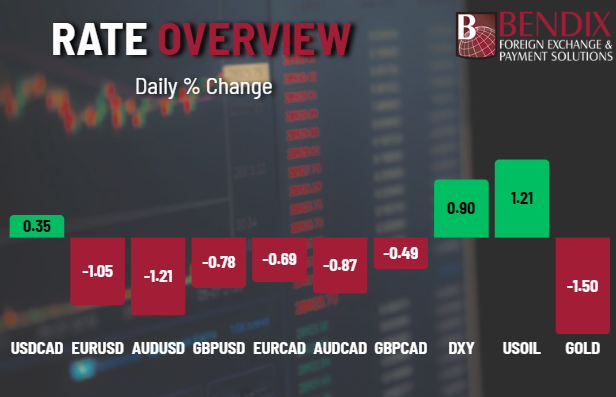
Earlier in the day, U.S. Advance Q2 GDP rose 3.0% over Q1, surpassing the 2.5% forecast and reversing last quarter’s -0.5% contraction. Private sector jobs increased by 104K in July, while wages rose 4.4% year-over-year, signaling continued labor market resilience. On the downside, pending home sales fell 0.8% in June and are down 2.8% on an annual basis, indicating softness in the housing sector. The economic divergence between the U.S. and Canada could reinforce USD strength, especially if markets begin to price in potential Canadian rate cuts more aggressively.
In Europe, Germany’s GDP contracted by 0.1% in Q2, partially offsetting the 0.4% uptick in Q1, which had been driven by tariff-driven front-loading activity. The euro has been on a downward tumble against both USD and CAD since the EU and U.S. announced a trade deal at the beginning of the week which imposes 15% tariffs on most European goods.
Current market conditions:
Ensure your business thrives amidst FX market changes—get in touch with Bendix to create a strategy that safeguards your currency positions.